
By the TileParlor Team
Published: August 2, 2026 · Fact-checked and reviewed: August 2, 2026
If you are buying American mahjong tiles and comparing melamine against acrylic, here is the short answer: the difference is not which material is “better.” It is how each material is manufactured, what makes it feel different at the table, and—critically—what you should ask before paying. Melamine begins as a thermoset compound poured into custom molds under heat and pressure; it produces dense, opaque tiles with a cool, substantial hand feel. Acrylic starts as large cast sheets—often layered, bonded, then cut—and delivers vibrant color depth, dimensional visual effects, and a lighter tactile presence. Both can be engraved, paint-filled, and customized. Both can be well-made or poorly made. Quality depends far more on mold precision, engraving depth, paint-fill consistency, edge finishing, and packaging protection than on the raw material name. This guide gives you a factory-facing checklist—drawn from Dongyu Tableware manufacturing experience and verified TileParlor product specifications—so your decision is based on questions you can ask a supplier, not on adjectives in a product description.
How Melamine Tiles Are Made
Melamine mahjong tiles are produced through compression molding. A thermoset melamine compound—the base color is mixed directly into the material—is poured into a custom-manufactured mold and cured under heat and pressure. Each tile emerges as a single, solid piece with the color running through the entire body. At Dongyu Tableware, the factory behind TileParlor, melamine compression molding is a core industrial capability extending well beyond mahjong into commercial tableware. That foundation informs how the team approaches tile production: mold precision, batch-to-batch color consistency, and post-molding finishing are treated as production-line disciplines.
Key points a buyer should understand:
- Mold and tooling: Each tile design requires a dedicated mold. For OEM projects, confirm mold cost, cavity count, and expected remaining mold life. A worn mold introduces dimensional drift and surface roughness.
- Color matching: Pigment is mixed into the compound before molding. Achieving a specific brand color requires a color-matching process and a pre-production sample for approval.
- Post-molding finishing: Tiles are tumbled and polished to soften edges. Over-tumbled tiles lose edge definition; under-tumbled tiles feel sharp.
- Decoration: Melamine tiles are engraved after molding, then paint-filled. Paint sits in recessed grooves below the surface, protected from direct finger friction. See our Materials & Craft guide for more detail.
At TileParlor, melamine specifications are confirmed at quotation—we do not publish a single fixed tile size or weight because different buyers need different configurations. The melamine page walks through each decision point: tile composition (160, 166, or custom), format, decoration, accessories, and packaging.
How Acrylic Tiles Are Made
Acrylic mahjong tiles begin as large cast sheets. For multi-layer designs, multiple sheets of different colors or finishes are bonded together, then the bonded block is cut into individual tile blanks. These are tumbled, polished, engraved, and painted—the same finishing sequence as melamine, but starting from a fundamentally different raw material.
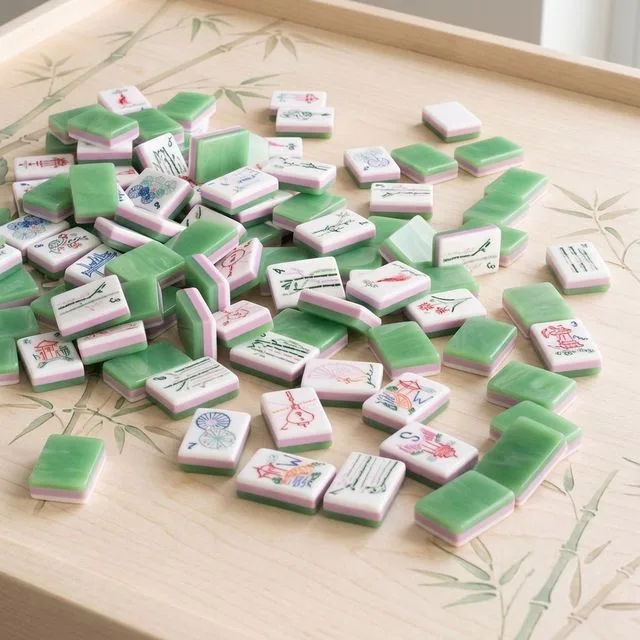
This layered construction creates acrylic signature visual advantage: the cross-section of bonded sheets is visible along tile edges, and light interacts with each layer differently. A three-layer tile like Miss Cowgirl (pink tiles with boot motifs) has a different profile from a single-marbled-sheet tile like Malachite Green (MAHJONG-030).
What to ask about acrylic construction:
- Layer count: More layers create more visual depth but also more bonding interfaces—each a potential failure point if bonding is inconsistent.
- Sheet quality: Lower-grade sheets may show micro-bubbles, haze, or uneven color. Ask for a close-up photo of the tile edge.
- Decoration method: Quality acrylic tiles are engraved and paint-filled. Some manufacturers use UV printing directly onto the surface instead. Printed decoration may wear faster because it is exposed to finger contact. Know which method you are paying for.
- Cutting tolerance: A tile measuring 1 inch wide on one end and 0.98 inches on the other will be visibly inconsistent when racked. Ask for dimensional tolerance.
Material Comparison at a Glance
The table below compares melamine and acrylic across the dimensions that matter for a purchasing decision. None of these rows declare one material “better.” They describe what to look for—and what to ask your supplier—in each case.
| Aspect | Melamine | Acrylic | What to Verify |
|---|---|---|---|
| Appearance | Opaque, uniform base color throughout the tile body. No transparency. Color is integral to the material. | Transparent to translucent. Layered sheets create depth. Marbling, shimmer, pearl, and gradient effects possible. | Are photos of the actual production batch? Does the pre-production sample match? |
| Feel & Weight | Dense, cool to the touch, stone-like. Typically heavier per tile than equivalently sized acrylic. | Lighter, warmer to the touch. Multi-layer tiles can be thicker overall but still lighter than melamine. | Request tile weight per unit. For bulk orders, weight × quantity determines freight cost. |
| Construction | Compression-molded as individual tiles. One-piece body. Color mixed into compound. | Cut from cast acrylic sheets. Multi-layer: sheets bonded before cutting. Single-layer: cut from one sheet. | Ask for layer count and bonding method (acrylic). Ask for mold age and cavity count (melamine). |
| Decoration | Engraved after molding, then paint-filled. Some designs incorporate molded-in surface detail. | Typically engraved then painted. UV printing also used by some manufacturers on acrylic and EVA. | Confirm: engraved-and-painted vs. UV-printed. Check paint-fill depth with a fingernail on a sample. |
| Wear & Surface | Engraved paint sits in recessed grooves—not exposed to direct finger friction. Surface scratches may show as lighter marks on darker colors. | Same engraving principle when paint-filled. Surface scratches on clear or light layers are more visible. Bonded-layer edges may show separation if bonding fails. | Inspect engraving depth uniformity. Check bonded edges for gaps or haze (acrylic). We do not publish durability conclusions without controlled wear testing. |
| Edge Finish | Tumbled and polished after molding. Edge color matches body color. | Cut, tumbled, polished. Layered edges reveal the cross-section of bonded sheets. | Check for chips, uneven rounding, sharp corners. Run a finger along all four edges of a sample. |
| Weight Verification | Weigh a random sample of tiles. Consistent weight = consistent density and mold fill. | Same approach. Weight variation across tiles may indicate sheet density inconsistency or cutting tolerance issues. | Weigh 10 random tiles from different positions. More than ±3% variation warrants a conversation with the supplier. |
| Replacement Tiles | Order from the same mold. Color matching requires batch control—pigment ratios must match the original run. | Order from the same sheet batch. Layered patterns are harder to match exactly across production runs. | Ask about replacement tile availability before committing. Confirm whether batch-matched replacements are possible. |
| OEM Questions | Mold cost, cavity count, color-matching rounds, MOQ, lead time, pre-production sample process. | Sheet availability, layer count, bonding quality, cutting tolerance, engraving method, MOQ, sample approval. | Get all OEM terms in writing before tooling begins. See the RFQ template below. |
The general manufacturing descriptions above are consistent with publicly available brand explanations, including My Fair Mahjong material guide (accessed August 2, 2026). That page describes manufacturing as a brand-level explanation—not an independent laboratory analysis. The comparison categories, factory-facing questions, and verification checklist are our own, based on Dongyu production experience.
What a Buyer Should Verify Before Ordering
Whether you are evaluating a single set or placing a wholesale order, these are checks you can run—or ask your supplier to confirm—before you pay. None require specialized equipment.
Flatness Check
Place a tile face-down on a known flat surface—a granite countertop, glass table, or machined level plate. Press each corner gently. If the tile rocks, it is not flat. Test at least 10 tiles from different positions in the case. One warped tile is an anomaly; ten is a mold or cutting problem. For melamine, warping typically indicates uneven cooling after molding. For acrylic, it can result from internal sheet stress or uneven cutting.
Edge and Corner Consistency
Run your thumb along all four edges and corners of at least 10 tiles. Edges should feel smooth and evenly rounded—not sharp, not chipped, not uneven. Acrylic layered tiles need extra attention: look at the bonded edge under good light for visible gaps between layers (delamination risk) or haze along the bond line (incomplete bonding).
Engraving Depth and Paint-Fill Quality
Under good light, inspect engraved lines on several tiles from different positions in the case. Engraving depth should look uniform—same groove width and depth on every character and suit symbol. Run a fingernail gently across the engraved area: you should feel the groove but not catch on it. Paint should sit fully within the engraving—no overflow, no unfilled sections, no color bleeding. On TileParlor Malachite Green (MAHJONG-030) and Miss Cowgirl sets, the specification confirms “painted after engraving.” OEM buyers should receive pre-production samples before the full run begins.
Color Consistency Across the Set
Spread 20-30 tiles face-up on a neutral surface in daylight or 5000K lighting. Look for shade variation. Melamine tiles from different batches or mold temperatures can vary. Acrylic tiles from different sheet batches may not match. For private-label orders with a specific brand color, request a colorimeter reading or physical swatch approval. Minor variation is normal; visible inconsistency at arm length is a reject criterion.
Packaging Protection
Ask your supplier: individual tile compartments, foam inserts, or divider trays? How many tiles share a compartment? What separates layers? If tiles can shift and rub during transit, they will show surface wear before reaching a table. For international shipping, ask about corner protection and outer-carton drop-test practices. Quick home check: hold the closed case and shake gently. If you hear tiles clicking, internal protection is insufficient.
RFQ Template: What to Send a Factory
Copy, fill in, and send this template to any manufacturer—including TileParlor. If a supplier cannot answer most of these fields, consider that a signal.
Subject: RFQ - American Mahjong Tile Set - [Quantity] Sets

Product / Model: [Name or model number]

Quantity: [Number of sets]

Please confirm:

Material & Construction
1. Material: Melamine / Acrylic / Other: _______________
2. If acrylic - number of layers: ___ ; bonding method: _______________
3. If melamine - mold cavity count: ___ ; remaining mold life: ___ cycles
4. Tile dimensions (W x H x Thickness): ___ x ___ x ___ (mm or inches)
5. Dimensional tolerance: +/- ___ mm
6. Tile weight per unit: ___ g

Decoration
7. Method: Engraved + paint-filled / UV-printed / Other: _______________
8. Engraving depth: ___ mm (if engraved)
9. Color-matching rounds included before production: ___

Set Composition
10. Total tile count: ___ tiles
11. Jokers: ___ (play) + ___ (spare) = ___ total
12. Blank tiles: ___
13. Accessories included (racks, pushers, dice, bag, mat, case): _______________

Packaging
14. Case / box dimensions: ___ x ___ x ___ cm
15. Internal protection type: _______________
16. Total package weight per set: ___ kg
17. Outer carton dimensions and sets per carton: _______________

Commercial
18. MOQ for this specification: ___ sets
19. OEM / customization MOQ: ___ sets
20. Sample lead time: ___ days
21. Production lead time: ___ days
22. FOB / CIF pricing per set: _______________
23. Shipping estimate to [destination]: _______________
24. Pre-production sample included? Yes / No - cost if separate: _______________
25. Replacement tile policy: _______________
How TileParlor Applies This to Real Products
Melamine: Specification-Led, Quotation-Confirmed
Our melamine range works through six decision points with every inquiry: tile composition (160, 166, or custom), format (size, thickness, weight, edge profile), decoration (base color, engraving design, paint fill), accessories, packaging, and commercial terms. Every specification is confirmed in writing before quotation. The melamine page explicitly lists the checks: character readability, engraving depth and paint-fill consistency, flatness and edge finish, color consistency, and packaging protection.
Acrylic: Verified Specs from Two Products
- Malachite Green (MAHJONG-030): 160 acrylic tiles, 10 jokers + 6 blanks, 1 in wide x 1-7/16 in tall x 7/16 in thick. Painted after engraving. Package: 27 x 17 x 13 cm, 2.5 kg. OEM MOQ: 200 sets (subject to project scope). A marbled-green single-sheet acrylic with a jewelry-like visual effect.
- Miss Cowgirl: 160 acrylic tiles at 1 x 1-7/16 x 7/16 in (25.4 x 36.5 x 11.1 mm). Pink, three-layer construction with painted-and-engraved boot motifs. Package: 16 x 23 x 6.5 cm, approx. 2.6 kg. OEM MOQ: 100 sets. Lead time ~25 days for 1-100 sets.
These are different expressions of the same material—different layer counts, visual effects, package dimensions, and MOQs. A buyer who knows to ask about these dimensions will understand the difference immediately. A buyer who only reads “acrylic” in the title will not. For more products, see the full catalog. For set composition questions alongside material choice, our 160 vs. 166 tile count guide covers that in detail. For custom projects, see OEM and wholesale.
A Note on Durability and “Which Lasts Longer”
We do not publish durability rankings because we have not conducted controlled accelerated-aging or abrasion testing on our current product lines. What we can say from production experience: the most common failure modes are not material-dependent—they are manufacturing-dependent. A poorly bonded acrylic tile delaminates. An unevenly cooled melamine tile warps. A shallow engraving with thin paint fill wears visibly within months regardless of material. Packaging that allows tile-to-tile contact produces chipped edges before the set reaches a table. None of these are material problems—they are quality-control problems. The checklist above is designed to catch them.
For general context on how materials factor into the broader set-buying decision, Goldielox published a buying guide on October 17, 2024, covering major trade-offs at a consumer level. It is a useful starting point; this article takes the next step into factory-facing verification.
Summary: Your Pre-Purchase Checklist
- Confirm material and construction method. Melamine = compression-molded, one-piece. Acrylic = sheet-cut, possibly layered. Ask for layer count and bonding method (acrylic); mold age and cavity count (melamine).
- Get tile dimensions and weight in writing. No assumptions about “standard size.” Dimensions, weight per unit, and tolerance should be on the spec sheet.
- Verify decoration method. Engraved-and-paint-filled offers recessed protection. UV-printed puts decoration on the surface. Know which you are paying for.
- Check flatness, edges, engraving, and color on a sample. If you cannot receive a sample, ask for close-up photos of these specific checks—not just beauty shots.
- Inspect packaging protection. Individual compartments or foam inserts. No tile-to-tile contact during transit. Confirm outer-carton practices for international orders.
- Ask about replacement tile policy. Batch-matched replacements are harder for layered acrylic and custom-color melamine. Know before you need one.
- Send the RFQ template above. Fill it in and send it. Compare responses. The supplier who answers every field understands what they are selling.
- Confirm everything before production begins. Pre-production sample, signed specification sheet, written quotation. No assumptions.
Questions? Ready to Request a Quote?
Browse our mahjong products, compare materials, or start a conversation about your OEM project. We confirm every specification before quoting.
This article was prepared using Dongyu Tableware manufacturing experience with melamine compression molding, verified TileParlor product specifications (Malachite Green MAHJONG-030 and Miss Cowgirl), publicly available brand material explanations from My Fair Mahjong (accessed August 2, 2026), and general buying context from Goldielox (published October 17, 2024). No market statistics, durability testing results, certification claims, or pricing data are cited without a dated, attributable, and independently verifiable source. All product specifications, stock status, and OEM terms are reconfirmed at time of quotation.
Leave a Reply